

Flow and Floods of the Amazon River
The Amazon River drains approximately 38% of continental South America and accounts for 15–16% of the total river water reaching the world’s oceans. The Amazon River’s flow is 5 times that of the Congo and 12 times that of the Mississippi, the largest rivers in Africa and North America, respectively. Estimates of Amazon River discharge has gradually increased in the past two decades as more measurements were made, and the river is now estimated to range on average between 215,000– 230,000 cubic meters per second. During the flood season, the Amazon River discharges so much water into the Atlantic that its sediment-laden whitewater can be seen approximately 160 km offshore. Because oceanic water is colder and “heavier,” the river’s waters flow over the surface of the sea.
Main tributaries of the Amazon and their contribution to the total flow of the river
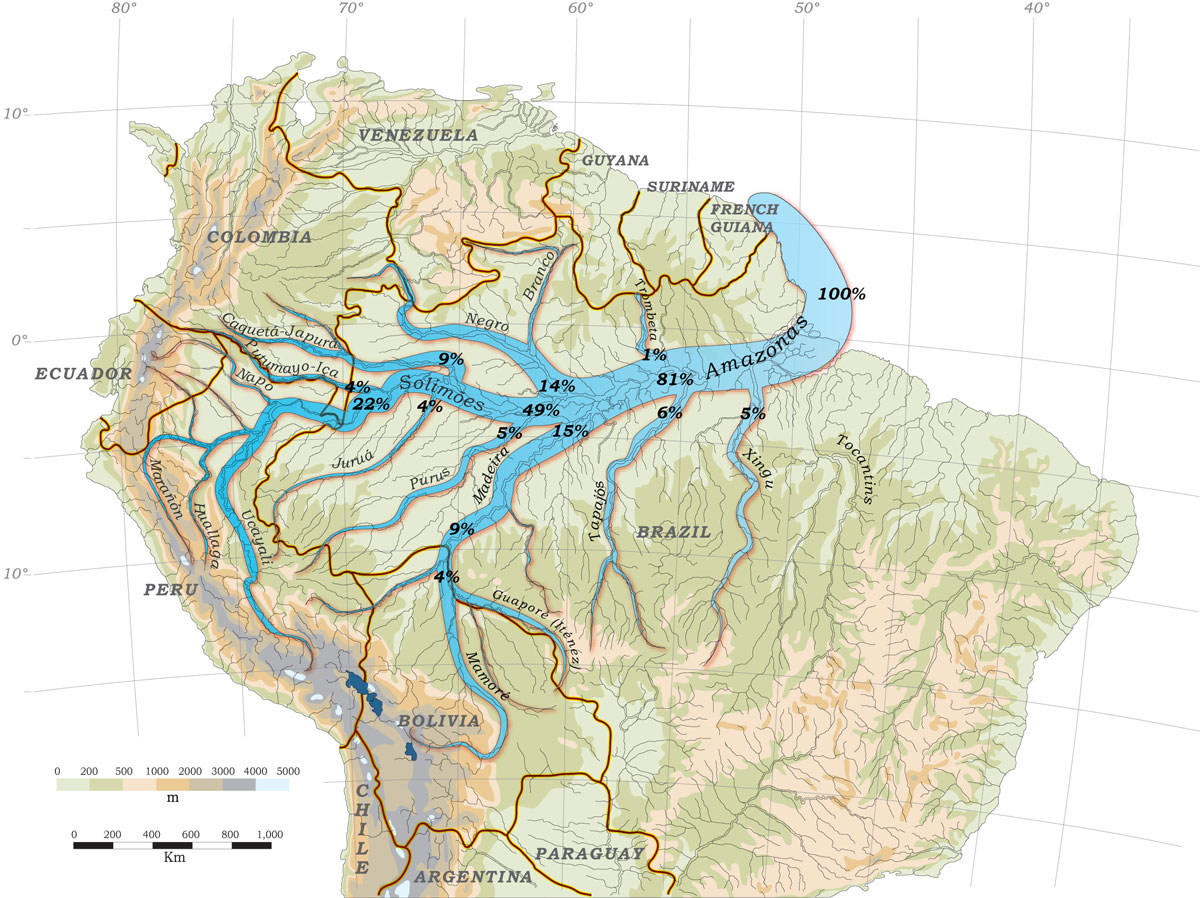
Source: Goulding, M., R.B. Barthem, E.J.G. Ferreira e R. Duenas. 2003. The Smithsonian Atlas of the Amazon. Washington: Smithsonian Books. 253.
Why are the flows and floods of Amazonian rivers important? One of the conservation targets of the Amazon Waters Alliance is to preserve biodiverse and functional floodplains that provide essential ecosystem services. We recommend reading A Guide to Saving the Amazon Basin.
———————–