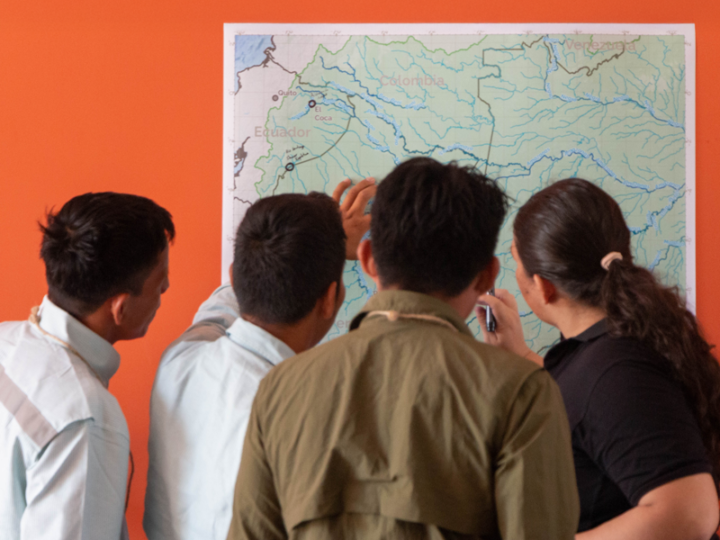

The Third Bolivian Congress of Ichthyology brought together researchers, students, and representatives of fishers from ten countries in a space for knowledge exchange, where scientific advancements and key contributions to biodiversity conservation, aquatic ecosystems, and fishery management were discussed.

Participants of the Third Bolivian Congress of Icthyology. Photograph: © Jesús Luna.
The Third Bolivian Congress of Ichthyology brought together researchers, students, and representatives of fishers from ten countries in a space for knowledge exchange, where scientific advancements and key contributions to biodiversity conservation, aquatic ecosystems, and fishery management were discussed.
Over three days, the dialogue integrated science, local knowledge, and proposals to strengthen fishery management, especially for emblematic species like migratory catfish. The wide-range participation made it possible to compare experiences among regions and deepen the understanding of current challenges for fish fauna.
The event was held from November 26 to 28 at the Universidad Mayor de San Andrés in La Paz, Bolivia, with the participation of partner institutions from the Amazon Waters Alliance, including the Centro de Innovación Científica Amazónica, the Institut de Recherche pour le Développement, Faunagua, WCS Bolivia, and WCS Ecuador, along with experts from Brazil, Peru, Chile, Argentina, France, Colombia, Mexico, Ecuador, Paraguay, and Belgium.
From Amazon Waters, Sannie Brum, specialist in biology and freshwater, presented the Alliance’s regional efforts to sustain commercial fisheries of migratory catfish through the keynote lecture “The migratory catfish connect us.” Other partner organizations shared research on new technologies to study mining wetlands, threats to the dorado catfish (Brachyplatystoma rousseauxii) in Bolivia, fish genetics (cryptic biodiversity), fish communities, and the ichthyofauna of the Llanos de Moxos.
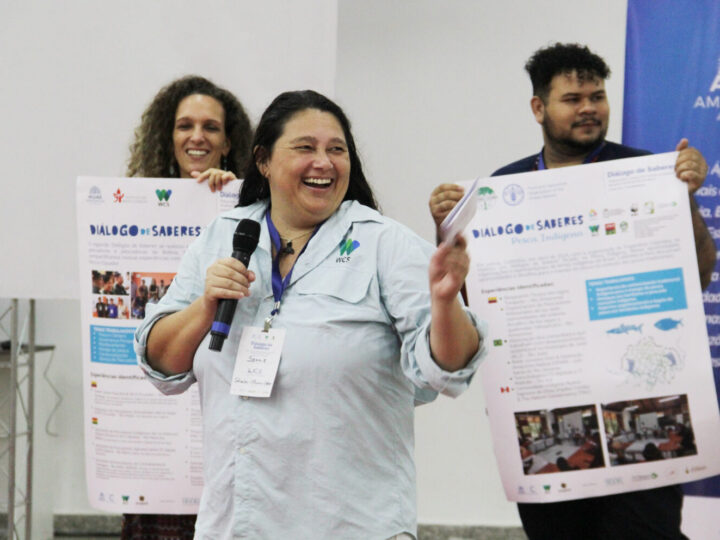
WCS participants presented two experiences in governance and fishery monitoring: the development of a participatory fishery agreement in the Beni River (Bolivia) and a citizen science initiative for managing fish resources in the Napo River Basin (Ecuador). Additionally, Sannie Brum led a discussion on fishing with technicians and fisheries from various countries.

Sannie Brum, liderando el conversatorio con pescadores y técnicos de países amazónicos. Fotografía: Jesús Luna
The Congress also hosted parallel exhibitions. One of them, still available to the university public, showcases traditional and scientific methods for fishing and field research: bow-and-arrow fishing used by the Mosetén, Yuracaré, and Moxeños peoples; gillnets for migratory fish; and ichthyoplankton nets to collect eggs, larvae, and juveniles, among other tools.
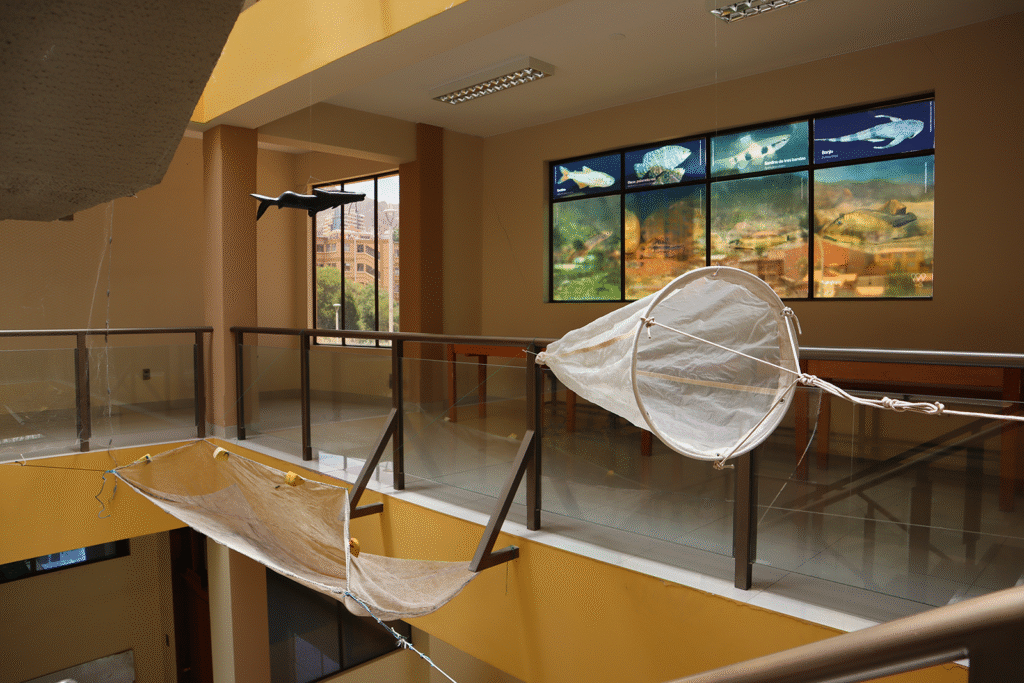
Exposición métodos de pesca. Fotografía: © Jhonny Nina / WCS Bolivia
The learnings from the third edition of the Bolivian Congress of Ichthyology help strengthen regional work. The knowledge exchange drives research, and enriches local and regional fishery management actions to conserve the integrity of the Amazon Basin.
The event was organized by WCS Bolivia, the Amazon Waters Alliance, the French Institute for Research and Development, the Institute of Ecology, the Biology Department of UMSA, Faunagua, the National Museum of Natural History, and the Bolivian Collection of Fauna; and supported by the World Wildlife Fund, Gordon and the Betty Moore Foundation, Critical Ecosystem Partnership Fund, Bezos Earth Fund, Amazon Conservation, the Aquatic Resources Research Center, and the Autonomous University of Beni “José Ballivián.”