
From April 7 to 9 in Manaus, Brazil, the workshop “Connecting Forests and Rivers: Integrating Data on Bushmeat and Fisheries for a Sustainable Amazonian Food System” brought together 25 participants from 18 organizations across the region, the United States, and Europe. The meeting, organized by Stanford University and the Amazon Waters Alliance in collaboration with the Center for International Forestry Research and World Agroforestry (CIFOR-ICRAF), and Instituto Juruá, convened specialists in biodiversity, fisheries, hunting, food security, and the social sciences to advance an integrated approach for Amazonian food systems.
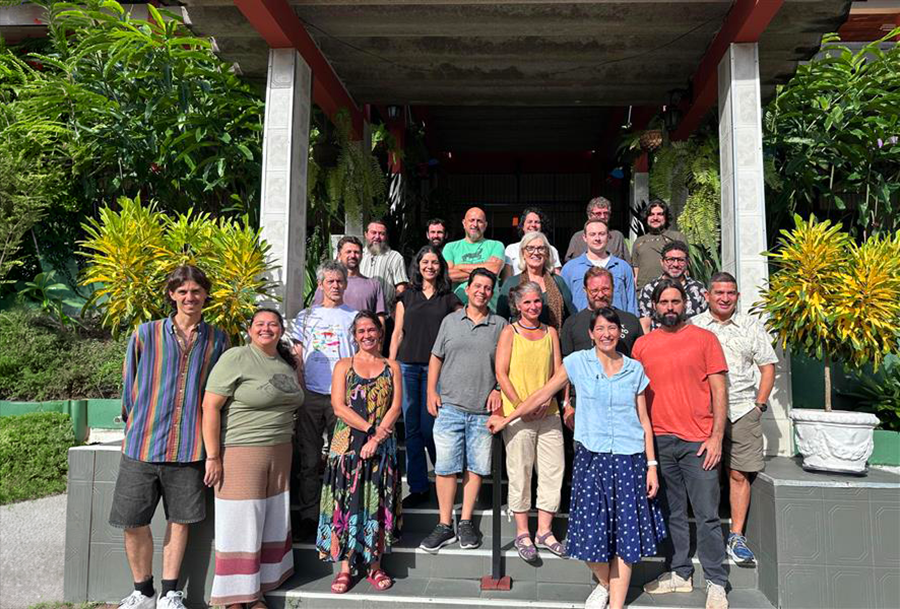
Participants of the workshop “Connecting rivers and forests” in Manaus, Brazil.
The urgency of this integration is clear. A recent study, based on more than 447,000 terrestrial wild animals recorded across 625 rural localities, estimates that approximately 0.34 million tonnes of edible wild meat are extracted annually in the Amazon. This source can supply nearly half of rural populations’ protein and iron requirements, in addition to providing B-complex vitamins and zinc. This importance of wildmeat is in addition to the well-known role of fisheries as a source of nutrition and livelihoods for the 47 million people that call the Amazon home.
Over these three days, synergies were identified between existing fisheries and bushmeat data. Drawing on initiatives such as the Marupiara database, with more than 440,000 hunting records, and fisheries monitoring platforms like Ictio, participants advanced the mapping of key variables—such as consumption, biodiversity, markets, nutritional value, and socioeconomic profiles—and identified information gaps.
As a result, existing datasets and priority variables for integration were defined, along with key research questions that link aquatic and terrestrial biodiversity, organized around focus areas like food security and nutrition, sustainability, health, socioeconomics, and governance, laying the groundwork for a shared research agenda.
In parallel, participants mapped a common framework towards data integration. It includes standards, governance principles, and initial agreements on information sharing and co-authorship. Concrete lines of work were also established, including the development of publications, research proposals, and reports to inform policies aimed at strengthening decision-making in conservation and food security.
Participants identified challenges for data integration. For example, while fisheries records often come from commercial activity, hunting records mainly reflect subsistence use, leaving aspects of both activities that are largely invisible in policy, research, and collaboration.
The workshop brought together two fields that often operate separately—fisheries and hunting—and defined a preliminary roadmap with responsible parties and a timeline for joint data analysis. This process contributes to more integrated planning, promoting aquatic-terrestrial connectivity and informed decisions that recognize the interdependence between forests and rivers in Amazonian food systems.
This work directly supports Amazon Waters strategy to strengthen sectoral and territorial planning with an integrated view of forests and rivers through the generation and articulation of knowledge that promotes aquatic connectivity and integrated basin management. The workshop was supported by the Gordon and Betty Moore Foundation and WCS.